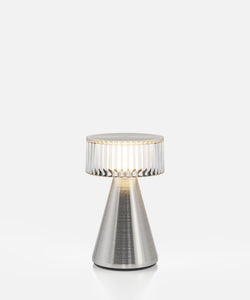

It is 5:45 pm. Evening service starts in an hour. A lamp on table 12 has a cracked diffuser. The table is booked. The question is not whether to fix it. The question is whether fixing it is possible at all.
For most cordless lamps, it is not. Sealed housings, proprietary components, and no parts infrastructure mean that a single failed component ends the useful life of the entire product. In a domestic setting, that is an inconvenience. In a hospitality environment where lamps are handled, charged, cleaned and moved across hundreds of services each year, it is an operational and financial problem that compounds quietly over time.
NEOZ lamps are designed around a different assumption. A well-designed product should not require replacement when a single part fails.
 Saint Peter at The Grand National Hotel, Sydney. The Piccolo cordless lamp in Brushed Bronze specified across the full dining room. Consistent at every table, from the first cover to the last.
Serviceability as a Design Requirement
Designing for repairability is harder than designing for assembly. A sealed product requires fewer decisions. A modular one requires the manufacturer to think about disassembly from the beginning: how components are accessed, how parts are identified, how tolerances hold across repeated handling, and how a product remains serviceable years after it leaves the factory.
For NEOZ, this was an engineering requirement, not a feature added later. Lamps are built to come apart cleanly, without specialist tools, by whoever manages the venue. That constraint shapes decisions at every stage of the design process, from how a diffuser seats in its housing to how a battery is specified and sized.
The result is a product that can be maintained rather than managed.
 Battery access on a NEOZ cordless lamp. One screwdriver, no specialist tools, no factory return.
What Can Actually Be Replaced
In practice, the components that determine a lamp's useful life are all accessible. Diffusers, batteries, LED light sources, lampshades, and charging components can each be replaced individually without retiring the lamp itself.
If a diffuser becomes marked or damaged, it can be swapped in minutes on-site. If a battery reaches the end of its cycle life, it can be renewed rather than discarded with the lamp attached to it. If a venue wants to refresh the appearance of a space after a few years, selected visible elements can be updated while the core lamp remains in service.
Replacement parts are available online, with clear pricing and no requirement for a service contract or factory return. For anything that needs guidance, a dedicated service advisor is available by phone or email. The lamp can also return to base for servicing when that is the more practical option.
This turns what would otherwise be a procurement decision into a fifteen-minute maintenance task.
What This Means at the Operational Scale
For a single restaurant managing 30 lamps, repairability means lower replacement costs and faster turnaround when something fails. For a hotel group maintaining 200 lamps across multiple properties, it means something more significant: consistency held over time.
A replaced lamp is rarely identical to the one it replaces. Finishes evolve between production runs. Tolerances shift. A dining room that looked considered in year one can look slightly inconsistent by year three if units have been swapped out piecemeal. Repairability keeps a fleet coherent in ways that replacement cannot.
Tables can continue to look the same in year four as they did in year one. For operators who have invested in a considered interior, that consistency has real value.
 LED module replacement. The assembled lamp remains intact while the component that needs attention is addressed separately.
A More Responsible Ownership Model
When a battery or diffuser can be replaced, the lamp stays in use. The aluminium body, the charging infrastructure, and the accumulated capital investment all remain productive. Only the failed component is renewed.
At the scale hospitality operators work, this matters. A hotel group repairing rather than replacing across a fleet of 200 lamps avoids manufacturing, shipping and purchasing 200 new products. The embodied material in the original lamp is not discarded. It continues to work.
This is not a sustainability claim built on abstraction. It is a straightforward outcome of a design decision made at the engineering stage: build it to last, and build it so that lasting is possible.
 Saint Peter at The Grand National Hotel, Sydney. The Piccolo in Brushed Bronze is in service. The lamp holds its place at the table the same way it did on opening night.
Closing
At 5:45 pm, with the evening service an hour away, the operator at table 12 needs one answer. With the right lamp, that answer is a replacement diffuser, not a replacement lamp. The repair takes less than fifteen minutes. Service starts on time.
A well-designed product should not require replacement when a single part fails. That principle is where NEOZ modular design begins, and it is what the system is built to deliver.
A lamp that can be repaired is a lamp worth keeping. Browse our full range of replacement parts.