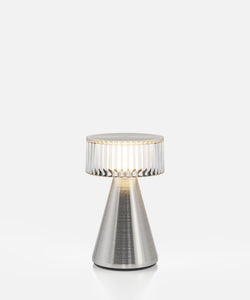

Most portable lamps look right at purchase. The real test is month 18 of nightly service in a 60-cover restaurant, running six nights a week. That is where the difference between consumer and commercial grade becomes impossible to ignore.
Consumer products are built for occasional use. Hospitality environments are not occasional. They are repetitive, demanding, and unforgiving of design decisions that were never made with commercial reality in mind. The question is not how a lamp performs on day one. It is how it holds up night after night, across a fleet, over years.
Charging Infrastructure:
A System, Not a Feature
In a commercial setting, charging is an operational consideration before it is a technical one. Individual cables create friction, clutter, and failure points that compound across a busy venue. Multi-dock charging allows entire lamp fleets to be managed in a single step, keeping back-of-house operations consistent and staff time focused on service rather than logistics.
Contact-based charging, using spring-loaded pins rather than exposed ports, removes a common failure point. Ports wear. Pins don't, at least not on the same timeline. In a lamp handled multiple times daily, that distinction accumulates into years of reliable use.
The less visible question is what happens when one dock unit fails. A commercial-grade charging system has redundancy built into its design. A consumer product pressed into commercial service typically does not.
 One charging station. For a venue running full covers across multiple spaces, that is the difference between a charging system and a charging problem.
Battery Performance: Beyond the Spec Sheet
Runtime figures require context. A quoted number often reflects a step-down from full brightness, which is worth understanding but not necessarily a problem. In hospitality settings where lamps are dimmed for atmosphere, the more relevant question is how performance holds across hundreds of charge cycles, not just on the first night.
High-grade lithium-ion cells, particularly those from established Japanese manufacturers, maintain capacity and stability over years of nightly use in ways that lower-grade alternatives do not. The difference is not always visible in year one. It becomes apparent in year two and three, when some lamps begin holding less charge and others do not.
The most important battery question, however, is whether it can be replaced. A sealed lamp with a degraded battery is a disposal decision. A lamp with a replaceable battery is a fifteen-minute repair. Over a five-year operating period, that distinction changes both the cost and the environmental calculation substantially.
 At this height, in open air, after a full evening of service, battery performance is not a specification detail. It is the difference between a lit table and a dark one.
Build Quality: What Commercial Grade Actually Means Structurally
Commercial grade is not a finish. It is a series of material and engineering decisions that determine how a lamp behaves under daily handling, cleaning chemicals, and the occasional knock from a passing service tray.
Zinc alloy die-cast, and forged brass are used not for visual weight but for structural resilience. These materials absorb impact and resist deformation in ways that lighter alternatives cannot sustain across years of commercial use. Surface finishes that look equivalent in a showroom reveal their differences after twelve months of cleaning with hospitality-grade products.
Weight distribution and base stability matter in ways that are easy to underestimate. A lamp that tips in a domestic setting is an inconvenience. In a busy dining room, it is a liability.
IP ratings establish a baseline for dust and moisture resistance, relevant for bar tops, outdoor terraces, and any environment where spills are routine rather than exceptional. What IP ratings do not capture is overall construction quality. Two lamps can share an IP54 rating and behave very differently over time. The rating is a starting point, not a conclusion.
 Sontaya, The St. Regis Saadiyat Island Resort. The Piccolo in stainless steel, specified across an outdoor terrace where humidity, heat and poolside exposure are nightly conditions, not exceptions.
Repairability: Where the Long-Term Difference Lives
Most consumer lighting effectively becomes disposable at the point of first failure. A cracked diffuser, a degraded battery, a failed LED module: any one of these ends the useful life of a product that was never designed to be opened.
Commercial-grade lighting takes a different position. Spare parts should be available, clearly priced, and accessible without a service contract or a factory return. Basic repairs should be possible on-site, without specialist tools, by whoever manages the venue. That is not a high bar. It is simply a design decision that most consumer products never make.
The financial case is direct. A replacement lamp carries the full cost of the original purchase. A replacement diffuser or battery does not. Across a fleet of 40 or 60 lamps over five years, the ability to repair rather than replace produces a materially different total cost of ownership.
The less discussed dimension is consistency. A replaced lamp is rarely identical to the one it replaces. Finishes evolve, tolerances shift, and a table that looked considered in year one can look slightly wrong by year three if units have been swapped out piecemeal. Repairability keeps a fleet coherent.
 Every part that can be replaced. That is the design intention.
Light Quality: Consistency Across a Fleet
High CRI, typically 90 and above, ensures that food, materials, and faces appear as they should under artificial light. This is well understood in hospitality specifications and is worth confirming for any lamp under consideration.
The less discussed issue is consistency across units. In a restaurant with 40 lamps, variation in colour temperature between individual units is not a theoretical problem. It is a visible one, particularly in open dining rooms where tables sit within sightlines of each other. A lamp specified at 2700K that varies by 150 to 200 Kelvin across a production batch produces a dining room that looks inconsistent in ways guests register without being able to name.
Tight manufacturing tolerances and quality control at the production level are what prevent this. They are not something a buyer can assess from a spec sheet. They are something to ask about directly, and to verify through sample units before committing to a full specification.
Dimming behaviour deserves similar attention. Smooth, flicker-free output at low levels allows a lamp to integrate into a broader lighting scheme. A lamp that flickers at 20% output or shifts colour temperature as it dims becomes a distraction rather than a contribution.
 At Ochre in London, the Cooee 1C sits at every table at the same colour temperature, in the same brushed brass finish. That coherence is not accidental. It is the result of tight manufacturing tolerances held across the full production run.
Compliance and Warranty:
Reading What the Documents Actually Say
Certifications such as CE, RCM, and UL exist for reasons that extend beyond regulatory formality. In a commercial setting, an uncertified product that causes injury or property damage creates liability exposure that insurance may not cover. Certification documentation should be available immediately on request. Hesitation at that point is worth noting.
Warranty terms require the same scrutiny. A five-year warranty is a useful benchmark for commercial specification, but the detail is what matters. Many standard warranties exclude commercial use explicitly, or include language that effectively voids coverage under the conditions a hospitality venue operates in daily.
A warranty that explicitly covers commercial use is not a generosity. It is a statement of what the manufacturer expects the product to withstand. That expectation, or its absence, is the clearest signal available about how a product is actually designed.
What to Ask Before You Specify
The following questions distinguish a commercial-grade product from a consumer product positioned commercially:
- What charging system is used, and how does it scale across a full venue?
- What battery cells are specified, and what is their expected performance after 500 charge cycles?
- Is the battery replaceable without replacing the lamp?
- What materials are used in construction, and how do they perform under repeated handling and cleaning?
- Are spare parts available without a service contract, and can repairs be carried out on-site?
- How consistent is colour temperature across production units, and how is that controlled at the manufacturing level?
- What certifications does the product hold, and can documentation be provided immediately?
- Does the warranty explicitly cover commercial use?
For specification enquiries, contact sales@neoz.com.au